In Plain English: Using Your Existing Legal Work Product to Fine-Tune a Large Language Model (Part 1 - Your First Dataset)
Right now, every law firm with the budget and the ambition should be fine-tuning their own large language model on their work product.
While the latter steps of the process are quite technical — the beginning steps are simple enough for you to start TODAY. In this first article in this series, I will break it down for you in plain English so you can take the first steps — without the need for any complex software.
Fine-tuning vs. Training
Training a model from scratch takes months of GPU-cluster-time and costs tens-of-millions of dollars. We will not be focusing on that. Instead, we will be focusing on fine-tuning existing models using methods like Supervised Fine Tuning (SFT) and Direct Preference Optimization (DPO).
Note: fine-tuning is for self-hosted models (Llama, Mistral, Gemma, Qwen) — not for enterprise models like Claude or OpenAI.
With that said — most law firms should absolutely be working both tracks: using their enterprise model AND ALSO working on fine-tuning their own model until it meets or exceeds their enterprise model on evaluations (which we will cover later in this series.)
The Golden Pair
The input for training and fine-tuning is just a simple combination of text: Prompt → Response.
Here's the key: Your existing work product IS the response. So your job is to WRITE THE PROMPT that would have produced your best existing work product. Yes, it really is that simple. And yes — later we can actually use AI to help us write the matching prompts. We will cover the software in another article, but for now it is perfectly fine to store those text combinations in a spreadsheet.
Your First Step: A Spreadsheet
Here's how you can start today with no complex software. Start a new spreadsheet. Start with 4 columns. Prompt, Filename (or link) of the work product, Client Matter Number, and Practice Area. Realistically you could just start with just the first 2 columns — but it'll make your life (and the Conflicts department's life) easier to track the last 2 columns from the start.
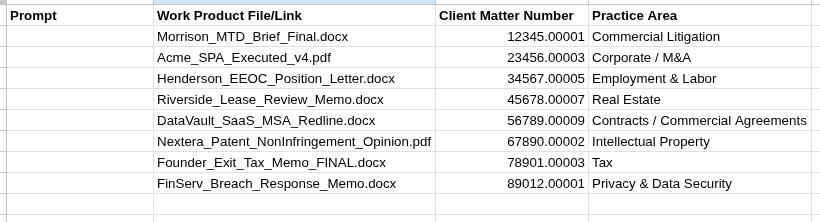
Prompt should be empty — it will now be your job (or your summer associate's job) to fill in that column.
Prompt Essentials and Examples
Here's how to write the perfect prompt, with concrete examples afterwards.
- Be jurisdiction-specific. Don't just say "write a motion." Say which court, which rule, which standard applies.
- Include the key facts. The prompt should contain enough factual context that someone unfamiliar with the matter could understand the core issue.
- Specify the argument structure. Don't leave the analytical framework to chance: tell the model which arguments to make and in what order.
- Name the audience. A memo for a sophisticated General Counsel reads differently than one for a first-time entrepreneur.
- Set tone and length. "Assertive but measured" is different from "aggressive." "8-12 pages" sets expectations.
- Reference controlling authority. If there are key cases or statutes that must be addressed, name them.
Here are 10 examples:
1. Litigation — Motion to Dismiss (12(b)(6))
Practice Area: Commercial Litigation
Draft a Rule 12(b)(6) motion to dismiss a breach of contract claim in federal court (District of Colorado). The plaintiff alleges our client breached a software licensing agreement by exceeding the licensed number of users, but the contract's user-count provision is ambiguous — it references "authorized users" without defining the term, and a reasonable reading supports our client's interpretation that it refers to concurrent users, not total accounts. Argue that the complaint fails to state a claim because the contract language, which we can consider on a 12(b)(6) because it's incorporated by reference, does not support the plaintiff's interpretation as a matter of law. Cite Ashcroft v. Iqbal and Bell Atlantic v. Twombly for the plausibility standard. Tone should be assertive but measured — this is a respected opposing counsel situation. 18-22 pages.
Why this prompt works: It specifies the jurisdiction, the legal standard, the key contract ambiguity, the procedural posture for considering the contract, and the controlling case law — all while setting a tone and page target. Nothing is left for the model to guess.
2. Corporate / M&A — Due Diligence Summary Memo
Practice Area: Mergers & Acquisitions
Write an internal due diligence summary memorandum for the acquiring company's general counsel regarding the proposed acquisition of a mid-market SaaS company ($80M–$120M enterprise value). The memo should cover: (1) corporate organization and capitalization issues, including a complex cap table with multiple preferred share classes and outstanding SAFEs that need conversion analysis, (2) material contracts risk, focusing on three customer contracts that contain change-of-control provisions triggered by the acquisition, (3) IP ownership concerns — two former engineers who contributed to the core product did not sign invention assignment agreements, and (4) an open employment dispute involving a terminated VP of Sales who has threatened but not yet filed a wrongful termination claim. Format as a structured memo with risk ratings (high/medium/low) for each category and recommended next steps. Audience is a sophisticated in-house counsel who wants concise analysis, not background education.
Why this prompt works: It defines the deal size (calibrating materiality thresholds), enumerates specific diligence findings the model needs to analyze, mandates a structured format with risk ratings, and specifies the audience's sophistication level to avoid generic explanatory content.
3. Employment Law — Employer-Side Position Letter
Practice Area: Employment / Labor
Draft a position letter on behalf of the employer (a 200-employee financial services firm in New York) in response to an EEOC charge of discrimination. The charging party, a former senior analyst, alleges race-based termination under Title VII. Our client's position is that the employee was terminated for documented, repeated performance deficiencies over a 14-month period, including three written warnings, a formal PIP, and failure to meet the PIP's specific benchmarks. The employee's direct supervisor, who made the termination recommendation, is the same person who hired the employee 3 years earlier — use the same-actor inference. Also address that two other employees (different races) were terminated under the same PIP process during the same period. Tone should be cooperative with the EEOC but firm on the legitimate business justification. Do not be combative. 8-12 pages.
Why this prompt works: It provides the complete factual narrative — the timeline, the documentation trail, the legal inference (same-actor), and the comparator evidence — giving the model everything it needs to construct a persuasive position statement without inventing facts.
4. Real Estate — Commercial Lease Review Memo
Practice Area: Commercial Real Estate
Write a lease review memorandum for our client, a regional restaurant group, analyzing a proposed 10-year commercial lease for a 4,500 sq ft space in a mixed-use development in Austin, Texas. The landlord's form lease is heavily landlord-favorable. Flag and analyze the following provisions: (1) the continuous operations clause that requires the tenant to remain open 7 days/week with no seasonal adjustment, (2) a co-tenancy clause that is missing entirely — our client needs protection if the anchor tenant (a national grocer) vacates, (3) the personal guaranty provision that requires unlimited personal guaranty from all members of the LLC with no burn-off, (4) the assignment/subletting provision that gives landlord absolute discretion to withhold consent, and (5) a CAM reconciliation provision with no cap and no audit rights. For each issue, provide the current language, explain the risk, and propose specific redline language the client should counter with. Audience is the client's CFO, not a lawyer — explain the business impact, not just the legal risk.
Why this prompt works: It identifies five specific provisions by name and describes the exact deficiency in each, requests three-part analysis for every issue (current language / risk / proposed redline), and calibrates the audience to ensure the output translates legal concepts into business terms.
5. Intellectual Property — Patent Non-Infringement Opinion
Practice Area: Patent Litigation / IP Counseling
Draft a non-infringement opinion letter for our client, a medical device manufacturer, regarding U.S. Patent No. [X],XXX,XXX, which covers a specific catheter tip geometry used in cardiovascular procedures. The patent's independent claim 1 requires a "tapered distal tip having a continuously curved outer surface with a radius of curvature decreasing monotonically from proximal to distal end." Our client's product uses a stepped taper design with three discrete conical sections rather than a continuous curve. Perform a claim construction analysis under Phillips v. AWH Corp., examining the claim language, specification, and prosecution history. Address both literal infringement (argue the stepped design does not meet the "continuously curved" limitation) and doctrine of equivalents (argue that the stepped design functions differently — discrete flow disruption vs. laminar flow preservation — and produces a different result). Include appropriate caveats about the limitations of the opinion. This should be thorough enough to support a good-faith defense. 15-25 pages.
Why this prompt works: It quotes the exact claim language at issue, describes the accused product's differentiating feature with technical precision, names the governing claim construction standard, and explicitly requests both literal infringement and doctrine-of-equivalents analysis — leaving the model no room to omit a critical argument.
6. Tax — Internal Memorandum on Transaction Structure
Practice Area: Tax
Write an internal tax memorandum analyzing the optimal structure for a founder's partial exit from a C-corporation (software company, $40M valuation, founder owns 60% of outstanding common stock). Compare three structures: (1) a stock redemption under Section 302, analyzing whether the redemption qualifies as "substantially disproportionate" or "not essentially equivalent to a dividend" given the remaining shareholders' ownership, (2) a cross-purchase by the other shareholders funded by an installment note, analyzing installment sale treatment under Section 453 and imputed interest rules under Section 7872, and (3) a restructuring into an S-corporation followed by a sale, analyzing the built-in gains tax under Section 1374 and the 5-year recognition period. For each structure, model the founder's approximate after-tax proceeds assuming current long-term capital gains rates, NIIT, and applicable state tax (California). Recommend the optimal structure with caveats. Audience is the senior tax partner for internal review before sending to the client.
Why this prompt works: It defines three distinct transaction structures with the specific Code sections governing each, requests quantitative after-tax modeling with specified tax rates and jurisdictions, and frames the audience as a reviewing partner — which naturally pushes the output toward citation-heavy, technically precise analysis.
7. Regulatory / Healthcare — Compliance Advisory
Practice Area: Healthcare Regulatory
Draft a compliance advisory memorandum for our client, a mid-size hospital system (6 hospitals, 3 states), regarding a proposed partnership with a physician-owned outpatient surgery center. The hospital would provide capital funding and operational management services in exchange for a management fee plus a percentage of net revenues. Analyze the arrangement under: (1) the federal Anti-Kickback Statute, evaluating whether the management contract safe harbor (42 C.F.R. § 1001.952(d)) applies — specifically address the fair market value requirement for the management fee and whether the revenue-percentage component disqualifies the arrangement, (2) the Stark Law physician self-referral prohibition, analyzing whether the arrangement creates a compensation relationship that triggers the referral prohibition and whether the personal services exception applies, and (3) applicable state self-referral and fee-splitting statutes for the three states in question (assume Texas, Florida, and Arizona). Provide a risk assessment and specific structural modifications that would reduce regulatory exposure. 12-18 pages.
Why this prompt works: It describes the business arrangement in sufficient detail for legal analysis, identifies the specific regulatory safe harbors and exceptions to test against, names the three state jurisdictions explicitly, and asks for both a risk assessment and actionable structural fixes — turning the memo from a passive analysis into a practical advisory tool.
8. Bankruptcy / Restructuring — Objection to Disclosure Statement
Practice Area: Bankruptcy
Draft an objection to the debtor's disclosure statement on behalf of our client, an unsecured creditors' committee, in a Chapter 11 case (Southern District of New York). The debtor is a retail chain with 140 locations. Our primary objections are: (1) the financial projections underlying the plan are unreasonably optimistic — they assume 12% same-store sales growth for three consecutive years despite the debtor's pre-petition trend of declining same-store sales and two recent competitor entries into key markets, (2) the disclosure statement fails to adequately disclose pre-petition insider transactions, specifically $3.2M in management consulting fees paid to an entity controlled by the CEO's spouse during the 18 months before filing, and (3) the liquidation analysis understates likely recoveries in a Chapter 7 scenario by using forced-sale valuations for real estate assets that have received unsolicited purchase offers at significantly higher amounts. Argue that the disclosure statement does not contain "adequate information" under Section 1125(a) and should not be approved for solicitation. Tone should be firm but not inflammatory — we want the court to order supplemental disclosure, not to alienate the debtor before plan negotiations. 10-15 pages.
Why this prompt works: It provides dollar figures, percentage assumptions, and specific factual predicates for each objection ground, cites the governing statutory standard ("adequate information" under § 1125(a)), and sets a relational tone objective — firm enough to win the motion, measured enough to preserve negotiating room.
9. Privacy / Data Protection — Incident Response Memo
Practice Area: Privacy & Cybersecurity
Draft a privileged and confidential incident response memorandum (attorney work product) for our client, a fintech company, following a data security incident. The facts: an unauthorized third party accessed a production database containing customer records for approximately 45 days before detection. The compromised data includes names, email addresses, dates of birth, last four digits of SSNs, and transaction histories for approximately 340,000 U.S. customers and 28,000 EU-based customers. Analyze notification obligations under: (1) applicable U.S. state breach notification statutes — the company is incorporated in Delaware, headquartered in New York, and has customers in all 50 states; address the varying definitions of "personal information" and whether last-four SSN digits trigger notification in key states, (2) the GLBA Safeguards Rule and any FTC notification requirements given the company's status as a non-bank financial institution, and (3) GDPR Article 33 (supervisory authority notification within 72 hours) and Article 34 (communication to data subjects) for the EU customers, including an assessment of whether the data qualifies as presenting a "high risk to the rights and freedoms" of data subjects. Include a recommended notification timeline, template structure for consumer notification letters, and a litigation hold recommendation. Mark as PRIVILEGED AND CONFIDENTIAL — ATTORNEY WORK PRODUCT throughout.
Why this prompt works: It specifies the exact data elements compromised, the affected populations with headcounts, the duration of exposure, and the multi-jurisdictional regulatory framework (50-state U.S. patchwork plus GDPR) — the level of factual and legal specificity needed for a memo that will guide the company's real-world response. It also explicitly demands privilege marking, which is essential for incident response work product.
10. Contracts — SaaS Agreement Negotiation Playbook
Practice Area: Technology Transactions
Create a negotiation playbook for our client (the customer, a Fortune 500 manufacturing company) for an enterprise SaaS agreement with a major ERP vendor. The initial contract value is $4.2M annually with a 3-year initial term. Structure the playbook as a provision-by-provision guide covering: (1) SLA and uptime commitments — the vendor's form offers 99.5% uptime; our target is 99.9% with meaningful service credits (not capped at 5% of monthly fees as proposed), (2) data ownership and portability — insist on clear customer ownership of all data, structured data export in standard formats at no additional cost, and a 180-day post-termination data retrieval period, (3) security obligations — require SOC 2 Type II certification, annual penetration testing with report sharing, 24-hour breach notification, and cyber insurance minimums, (4) limitation of liability — the vendor's form caps liability at 12 months of fees paid; push for a general cap at 24 months with carve-outs for IP indemnification, data breaches, and confidentiality violations, (5) termination rights — insist on termination for convenience with 90 days' notice after the initial term, and termination for cause with a 30-day cure period, and (6) auto-renewal — change from automatic 3-year renewal to automatic 1-year renewal with 90-day opt-out notice. For each provision, provide: the vendor's likely starting position, our ideal position, our fallback position, and the business justification for our position. Tone should be practical and business-oriented — this will be shared with the procurement team, not just legal.
Why this prompt works: It anchors on a real contract value and client profile, specifies the vendor's opening position and the client's target for each provision, mandates a four-part structure for every issue (vendor position / ideal / fallback / business justification), and sets the audience as procurement — ensuring the output is operationally usable, not just legally sound.
Your Move
Start today. Open a spreadsheet, pull your ten best pieces of work product from the last year, and write the prompts. That's it. You don't need a data scientist. You don't need a GPU cluster or permission from IT. You just need your best work and one hour.
Next up: how to use AI to turn 10 hand-written prompts into hundreds — and eventually, how to transform your spreadsheet into usable fine-tuning data.